
THE SUBTRACTION METHOD: The Best Face Hack Costs Nothing



At some point – and it’s different for everyone – the ritual stops being about self-care and starts being a negotiation. Another layer, another promise, and yet another small act of faith in a bottle that costs more than it should and delivers less than it claims.
Deep down you know this but, you do it anyway.
Because the alternative is standing in front of a mirror with nothing between the raw you and whatever you see reflected there.
The cost is more than an empty bank account or counter full of empty promises, it’s the slow erosion of self-confidence that no matter what you do; there’s no improving the look of you.
We have been trained to believe that beauty is an accrual: more serums, more steps, and more tiny glass bottles promising to fix what time, genetics, or last night supposedly ruined. The industry has built an entire cosmology around addition, as if the face you woke up with were only a draft in need of revision, and the only path to improvement is through purchase.
Yet here is the quiet heresy no one sells because it cannot be packaged: sometimes the thing obscuring your face is not a lack but an excess. It is not character lines or collagen loss; it is the simple, unglamorous truth of fluid that has not moved along as it should. The kind of congestion that settles in when life becomes busy, stress grows loud, and sleep has gone from daily guarantee to nightly negotiation.
This is where subtraction enters, not as a metaphor but as a method.
It does not require a twelve-step routine or a dermatologist’s blessing. It requires only your hands, a simple tool, and the willingness to consider that your face might not need more but less. Less swelling, less stagnation, and less of the physiological noise that blurs the architecture you already have.
Subtraction Is Rebellion
For decades, the beauty industry has convinced women that the only way forward is more — more layers, more additives, and more protocols than a stacked Jenga tower of hope.
But the older I get, the more I trust the quiet math of subtraction.
One of the most effective things you can do for your face does not work by adding anything at all. It works by removing what should not be there in the first place: the fluid that overstays its welcome, the stagnation that softens your angles, and the physiological clutter that makes you look tired even when you are not.
Sometimes the thing obscuring your face is not a lack but an excess.
Subtraction is not glamorous; it doesn’t sparkle on a shelf, yet it is the closest thing to the truth of what you need in a landscape otherwise built on exaggeration. When you take away what distorts the picture, what remains is the face you actually have: sharper, clearer, unburdened.
The System Sans a Pump
Here is the part no serum bottle has ever bothered to mention: your body is a marvel of built-in machinery, but not every system comes with its own engine. Your circulatory system has the heart, a tireless, metronomic workhorse. Your digestive system has peristalsis, those quiet muscular waves that keep everything moving whether you are paying attention or not. But your lymphatic system, the one responsible for clearing waste, excess fluid, and the microscopic debris of simply being alive, has no pump at all. Not a single internal mechanism exists to push that fluid along.
It relies entirely on movement — your movement.
Breathing deeply, turning your head, walking, sleeping, and even laughing. And when life becomes modern, sedentary, and stressful, when your shoulders live somewhere near your ears and your jaw remains clenched through half the day, that system slows to a crawl. Not because it is broken, but because it is waiting for you.
This is the moment most women finally understand why fluid accumulates, why the face looks different at seven in the morning than it does at noon, and why the under-eye area can betray you even when you have done everything right.
It is not a flaw; it’s logistics.
Congestion Is the Mirror
Much of what reads as tired, puffy, or mysteriously less defined has nothing to do with aging, bone loss, or some imagined deficiency you are supposed to fix with a $300 cream.
Most of what you see in the mirror is congestion: fluid that has not moved, waste that has not cleared, and a system doing its best without the internal machinery it was never given. Your face is not betraying you; it is waiting for relief.
What often reads as fatigue is a lymphatic system struggling to keep pace.
The Quiet Consensus
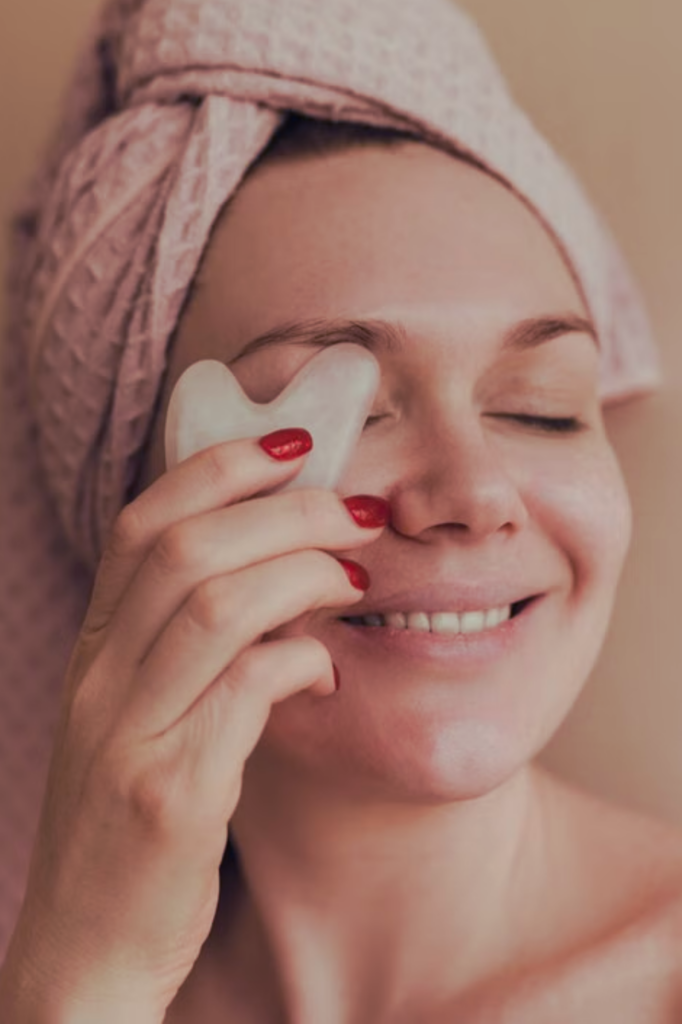
If you truly want to understand the quiet power of gua sha, look at the women who have every option available to them: the ones who could book a laser at lunch and a facialist before dinner, yet still keep a stone in their bathroom drawer as if it were non-negotiable.
Margot Robbie, at thirty-five, does not talk about sculpting; she talks about de-puffing before cameras that capture pores in 8K. Dakota Johnson treats it like brushing her teeth, a morning ritual that wakes her face before the world has a chance to read it. Meghan Markle folds it into her tension-release routine with the same quiet intention she brings to everything else. And Salma Hayek, nearly sixty, swears by massage to keep her skin elastic rather than ethereal.

These women are maintaining clarity, clearing what life deposits, and supporting a system that does not have its own engine. When women with access to everything still choose the simplest tool in the room, it is not a fad; it is infrastructure.
Manual Clarity
There are certain beauty practices that don’t rely on a med-spa or a soft-focus origin story to justify themselves — protocols that maintain who you are through consistent nurturing and habits, like brushing your teeth or finally drinking the water you’ve been pretending to drink all day: not ritual, not mysticism, just routine maintenance.
Gua sha lives there.
Five minutes with a simple stone can provide manual lymphatic stimulation that coaxes fluid from the places it lingers — the jawline, nasolabial folds, and under-eye area, the pockets where stress and sleep deprivation like to settle—toward the places it can actually be processed. Think of it as infrastructure, a hands-on assist for a system that was designed without its own engine.
The result is your face, unburdened.
The Face Returns
Gua sha doesn’t give you a new face. It gives you back the one that has been hiding beneath the late nights, stress hormones, salt, screens, and everything else you try to sneak into your body, with the hopes it won’t notice or punish you too harshly.
Once you understand what is actually happening under the skin, a gua sha practice stops being about vanity and becomes something closer to stewardship. You are clearing. You are supporting a system that was never designed to handle the pace, pressure, and posture of contemporary life.
Five minutes of intentional touch is not self-indulgence; it’s maintenance, circulation, and the kind of small, consistent act that makes you look better because it makes you feel better — and the body always tells the truth before the mirror does.
A sharper jawline is the visible benefit, although you will get that. The real payoff of gua sha is the quiet, almost private satisfaction of realizing that your face was never the problem – the congestion was.
Once you clear it, what returns is not just definition.
It is you.